
Town Guides · Explore Central Utah · Utah County
Spanish Fork, Utah — where the corridor begins, and what you're trading as you drive south.
A city of roughly 50,000 people with full infrastructure and a Provo-area commute. The honest guide before you decide how far south to go.
Photo: Josh Sorenson / Pexels
Where the corridor starts
Most families researching a move along the Spanish Fork to Nephi corridor start here — and then drive south to figure out how far they're actually willing to go.
Spanish Fork has roughly 50,000 people in 2026. It's the 20th largest city in Utah, part of the Provo-Orem metropolitan area, and has a median household income of approximately $104,844. This is not a small town on the edge of something — it's a real city with full city infrastructure, and it's where the corridor story begins.
This guide covers what Spanish Fork actually offers, what it costs, how it compares to towns further south, and who it actually fits.
Population and demographic data sourced from publicly available census and survey sources. Figures are estimates and subject to change. Verify current information before making decisions based on this guide.
The Scale — By the Numbers
A city, not a small town on the edge of one.
Spanish Fork's 2026 population is estimated at approximately 50,000, up 17% from the 2020 census count of 42,762, and growing at roughly 2.5% annually. It is the 20th largest city in Utah and sits within the Provo-Orem metropolitan statistical area. Median household income is approximately $104,844 — meaningfully above the figures for towns further south in the corridor.
Median age is approximately 28.3 years, reflecting a notably young, family-oriented demographic. Roughly 56% of households have children under 18. Cost of living remains below the national average despite the city's size and infrastructure.
Spanish Fork at a glance
2020 Census Population
42,762
2026 Estimated Population
~50,000
Growth Since 2020
~17%
Median Household Income
~$104,844
Median Age
~28.3 years
Metro Area
Provo-Orem MSA
Cost of Living
Below national average
What Spanish Fork Actually Has
The infrastructure to match the size.
Spanish Fork is the most fully developed city at the southern end of Utah County, with the infrastructure to match its size. Full retail — grocery chains, big-box stores, restaurant variety — is available locally without requiring a drive north to Provo or south through Payson.
The city has direct freeway access on I-15, placing it within reasonable daily commuting distance of the broader Utah County employment market. Canyon access is available east of town, and Utah Lake is accessible to the northwest — giving residents both mountain and water access within a reasonable drive.
For most daily needs — groceries, restaurants, medical, retail, recreation — Spanish Fork functions as a self-contained city. That's the practical difference between it and the smaller towns further south along the same freeway.
The Spanish Fork River Trail
Six or seven miles of flat, paved, genuinely accessible trail.
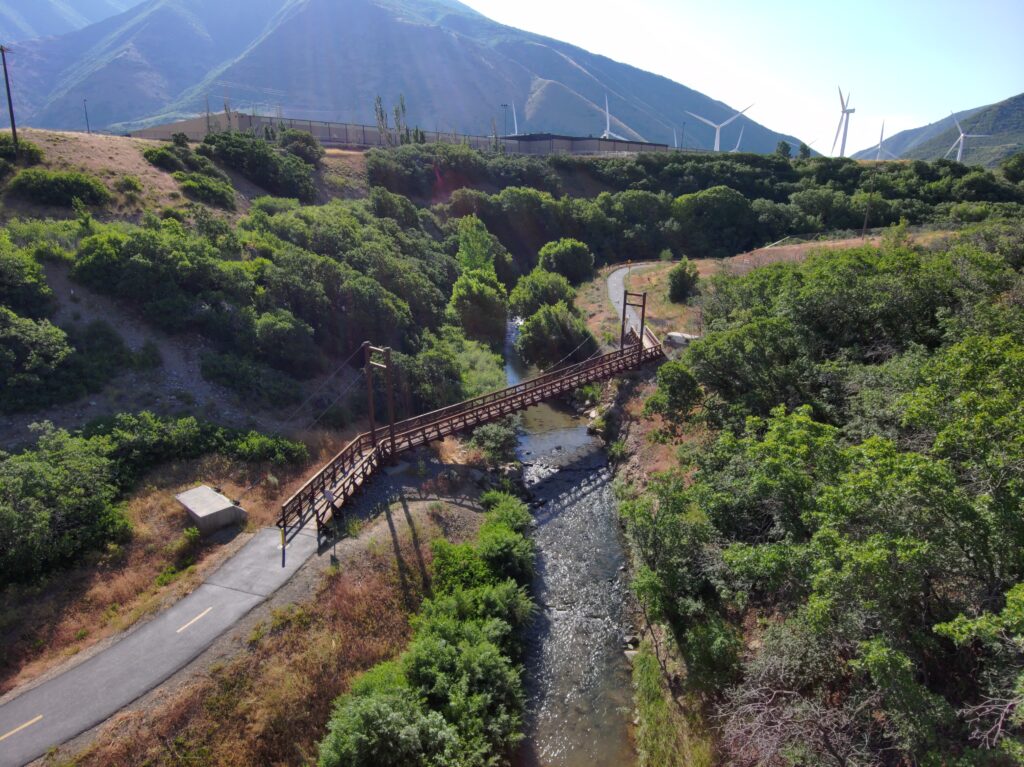
The Spanish Fork River Trail is a 6-to-7-mile paved multi-use trail running along the Spanish Fork River through the city. It is completely flat, stroller-friendly, and wheelchair accessible — making it one of the more genuinely family-accessible trails in Utah County.
The trail is popular with walkers, cyclists, and runners, and sees noticeably less traffic on weekday mornings than comparable trails further north in the Provo-Orem area. Dogs are welcome on leash. Best parking access for families is Canyon View Park off Canyon Road. It is one of the underused amenities in the city that locals consistently cite as a reason for staying.
The Commute
The southernmost realistic anchor for a Provo-area workday.
Spanish Fork sits within the Provo-Orem metropolitan area, which means the broader Utah County employment market is genuinely accessible for daily commuters. The city's I-15 access makes drives north to Provo and Orem — and further to Salt Lake County for some commuters — a realistic daily routine in a way that becomes progressively less practical as you move south through Payson, Santaquin, and into Juab County.
For households where one or both earners need regular Provo-area access, Spanish Fork is the southernmost realistic anchor before the commute math starts to shift significantly.
Every Mile South Is a Tradeoff
The corridor makes sense once you frame it as a series of trades.
This is the framing that makes the corridor make sense: every mile south of Spanish Fork is a real and deliberate trade. Payson, 6 miles southwest, gives you a smaller community feel and slightly lower prices in exchange for fewer local amenities. Santaquin, another 7 miles south, gives you more space and a quieter pace in exchange for driving to Payson or Spanish Fork for most services. Nephi, another 20 minutes beyond that, gives you genuine rural life, Juab County's lower price points, and canyon access — in exchange for the full infrastructure Spanish Fork offers.
None of these is the wrong trade. They're just different decisions about what daily life should look and feel like. The question is which side of each tradeoff matters more to your family.
I've had buyers who visited Spanish Fork, drove south to Nephi for a showing, and immediately knew one of the two was wrong for them — before they even looked at the house. The drive itself tells you something. Take it before you make a decision.
Who Spanish Fork Is Actually For
The northern anchor that gives the southern options their context.
Spanish Fork fits families who want a full Utah County city experience — real restaurant variety, full retail, recreation infrastructure, and a Provo-area commute that doesn't require a major life restructuring — while staying south of the density and price points of Provo and Orem proper. It's the most practical choice for households anchored to the Utah County job market who want to live further from the city's core.
It's a less natural fit for buyers specifically searching for the rural pace, open space, and price points that Juab County offers. The corridor exists because both types of buyers exist — and Spanish Fork is simply the northern anchor that gives the southern options their context.
FAQs
Spanish Fork, Utah FAQs
Keep Reading
Comparing Spanish Fork to other corridor towns?
Disclaimer: Population, income, and demographic figures referenced in this post are sourced from publicly available census and demographic data and are subject to change. Always verify current information before making decisions. This post is for general informational purposes only — no opinions about specific community groups, demographics, or protected classes are expressed or implied. Dana Hoyt is a licensed Realtor® in Utah with Summit Keys Real Estate and Real Brokerage, LLC The Perry Group.
